Distributed Task Scheduling Platform
Fault-tolerant task scheduling platform handling high-volume event processing.
DynaQ Distributed Task Scheduling Platform
Multi-tenant, serverless task scheduling architecture with dual-path optimization
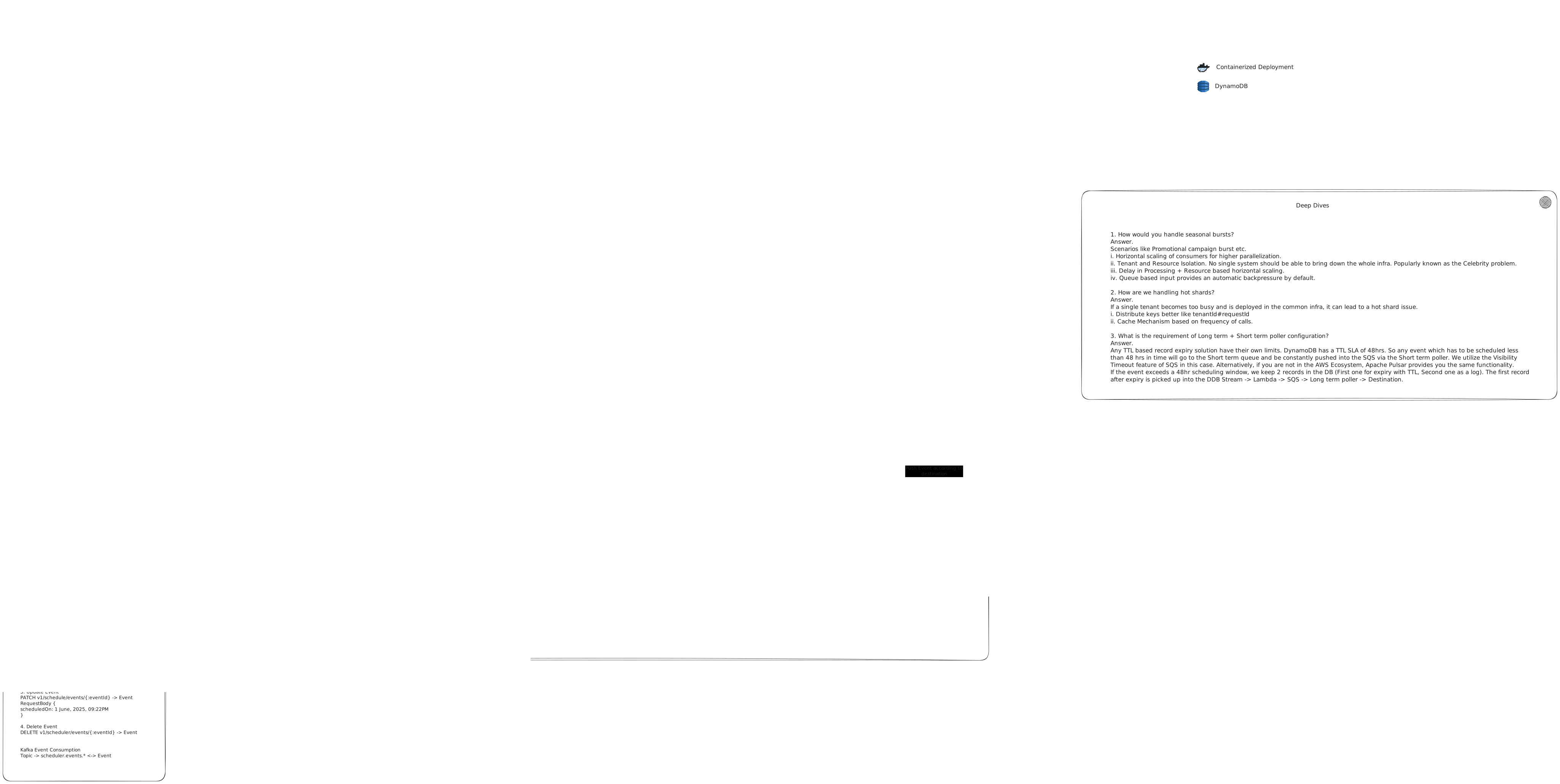
1. System Overview
DynaQ is a multi-tenant, distributed task scheduling platform designed to abstract away the complexities of time-based task execution for applications within the Jupiter ecosystem. The system provides a reliable, scalable, and event-driven alternative to traditional cron-job based scheduling solutions with support for both short-term and long-term task scheduling optimizations.
Core Capabilities
- • Multi-tenant Isolation: Complete resource isolation with configurable storage and consumer patterns
- • Dual Scheduling Architecture: Optimized for short-term (<48h) and long-term (>48h) tasks
- • Multiple Destinations: SQS, HTTP endpoints, and Kafka topics for flexible delivery
- • At-least-once Delivery: Guaranteed delivery with comprehensive retry mechanisms
- • Complete Audit Trail: Full task lifecycle tracking for compliance and debugging
Impact Metrics
- • 300k+ tasks/day processed reliably across multiple tenants
- • 99.9% uptime with fault-tolerant design and auto-recovery
- • 60% reduction in operational overhead through automation
- • 10+ tenants supported with complete isolation
- • Zero downtime incidents with self-healing mechanisms
System Boundaries & Scope
In Scope:
- • Multi-tenant task scheduling with resource isolation
- • REST APIs for task management and monitoring
- • Dual architecture for short/long-term optimization
- • Multiple destination types (SQS, HTTP, Kafka)
- • Complete audit trail and lifecycle tracking
Out of Scope:
- • Cron-style recurring tasks (future release)
- • Real-time streaming data processing
- • Complex workflow orchestration
- • Direct database query scheduling
- • File system or object storage triggers
2. Actors & Usage Patterns
Human Actors
Application Developers
Create and integrate tenant applications with DynaQ scheduling APIs. Configure task destinations and manage scheduling workflows.
System Administrators
Monitor system health, manage tenant configurations, and oversee platform operations and maintenance.
Operations Team
Handle incident response, capacity planning, performance optimization, and system maintenance activities.
Business Stakeholders
Review usage patterns, analyze cost optimization opportunities, and drive business requirements.
System Actors
Tenant Applications
Jupiter ecosystem services that schedule and consume tasks through DynaQ APIs.
AWS Lambda Functions
Automated processors for task migration, execution checking, and delivery mechanisms.
Storage Systems
DynamoDB for long-term tasks, SQS for short-term tasks, and DynamoDB Streams for event triggers.
External Systems
HTTP endpoints, Kafka topics, monitoring systems, and audit platforms for task delivery and observability.
Usage Patterns & Use Cases
High-Volume Transactional
- • E-commerce order reminders and notifications
- • Payment processing and settlement tasks
- • Real-time fraud detection follow-ups
- • Transaction status update broadcasts
Administrative & Reporting
- • Monthly and quarterly report generation
- • Data archival and cleanup processes
- • Regulatory compliance reporting
- • System health check notifications
Event-Driven Workflows
- • User action follow-ups and reminders
- • Workflow continuation after delays
- • Marketing campaign trigger scheduling
- • Customer engagement automation
Compliance & Regulatory
- • Data retention policy enforcement
- • Audit trail generation and reporting
- • Regulatory deadline reminders
- • Compliance validation scheduling
Scheduling Patterns & Characteristics
3. Architecture Design
DynaQ Multi-Tenant Task Scheduling Architecture
Serverless dual-path scheduling system optimized for short-term and long-term task execution
Design Goals
System Boundaries
Input Boundary
REST APIs for task creation, tenant management, and monitoring operations
Processing Boundary
Internal scheduling engines, Lambda functions, and data processing pipelines
Output Boundary
Destination delivery mechanisms (SQS, HTTP endpoints, Kafka topics)
Storage Boundary
DynamoDB for long-term tasks, SQS for short-term tasks, audit tables
Management Boundary
Administrative APIs, monitoring dashboards, and operational tools
Core Components
Scheduler Core (API Gateway + Lambda)
- • Processes task creation and routing decisions
- • Handles tenant authentication and authorization
- • Intelligent routing based on 48-hour threshold
- • Task management APIs (create, update, cancel, query)
- • Input validation and business rule enforcement
Long-term Scheduler (DynamoDB)
- • Stores tasks scheduled more than 48 hours ahead
- • Automatic TTL-based migration to short-term scheduler
- • Tenant-isolated storage with configurable retention
- • DynamoDB Streams trigger task migration
- • Supports task updates and cancellations
Short-term Scheduler (SQS)
- • Handles tasks scheduled within 48 hours
- • Uses SQS visibility timeout for precise timing
- • High-throughput processing with minimal latency
- • Configurable retry policies with exponential backoff
- • Dead letter queue management for failed tasks
Execution Engine (Lambda)
- • Polls SQS queues for ready-to-execute tasks
- • Multi-destination delivery (SQS, HTTP, Kafka)
- • Retry logic with failure tracking
- • Real-time metrics and status reporting
- • Audit trail integration for compliance
Data Flow & Processing Pipeline
4. Technology Decisions & Trade-offs
Core Technology Stack
Compute Layer
- • AWS Lambda: Serverless execution for all processing
- • API Gateway: RESTful API management and routing
- • Go Runtime: High-performance, low-latency processing
- • Event-driven: DynamoDB Streams and SQS triggers
Storage Layer
- • DynamoDB: Long-term task storage with TTL
- • SQS: Short-term task queuing with visibility timeout
- • DynamoDB Streams: Real-time change capture
- • CloudWatch: Metrics and logging
Integration Layer
- • SQS Destinations: Internal queue delivery
- • HTTP Clients: External endpoint notifications
- • Kafka Producers: High-throughput messaging
- • SNS: Fan-out notifications
Key Architectural Decisions
Serverless Architecture
Decision: AWS Lambda + API Gateway for all compute
Rationale: Zero operational overhead, automatic scaling, pay-per-use cost model, and built-in high availability
Dual Scheduling Architecture
Decision: DynamoDB for long-term, SQS for short-term tasks
Rationale: DynamoDB TTL uncertainty requires 48-hour buffer; SQS visibility timeout perfect for short-term precision
At-least-once Delivery
Decision: Guarantee delivery over exactly-once semantics
Rationale: Simpler implementation, better performance, tenant applications handle idempotency
RESTful APIs
Decision: HTTP/REST over message-based protocols
Rationale: Standard integration patterns, better tooling support, easier debugging and monitoring
Storage Technology Comparisons
DynamoDB vs RDS (Long-term Storage)
Winner: DynamoDB
Pros: TTL automation, serverless scaling, no operational overhead
Cons: Limited query flexibility, eventual consistency
Trade-off: Operational simplicity over query capabilities
SQS vs Kafka (Short-term Storage)
Winner: SQS
Pros: Serverless operation, visibility timeout, managed service
Cons: Limited throughput per queue, message size limits
Trade-off: Operational simplicity over raw throughput
Lambda vs Container (Compute)
Winner: Lambda
Pros: Zero infrastructure management, automatic scaling
Cons: Cold start latency, 15-minute execution limit
Trade-off: Operational simplicity over performance control
Alternative Solutions Analysis
| Solution | Pros | Cons | Decision |
|---|---|---|---|
| AWS EventBridge | Cron support, Lambda triggers | No arbitrary timestamps, expensive for high frequency | ✗ Rejected |
| Celery + Redis | Mature ecosystem, good retry mechanisms | Complex infrastructure, operational overhead | ✗ Rejected |
| Quartz Scheduler | Feature-rich, clustering support | Infrastructure requirements, Java-specific | ✗ Rejected |
| Kubernetes CronJobs | Container-based, horizontal scaling | Cron-only, cluster management overhead | ✗ Rejected |
| DynaQ (Custom) | Exact requirements fit, AWS native, multi-tenant | Custom development effort, maintenance responsibility | ✓ Selected |
Technical Constraints & Limitations
AWS Service Constraints
- • DynamoDB TTL: Up to 48-hour delay requires dual architecture
- • SQS Message Limits: 256KB payload limit for task data
- • Lambda Timeout: 15-minute maximum execution time
- • API Gateway: 30-second timeout for synchronous responses
Design Limitations
- • Regional Deployment: Single-region initially, limited global latency
- • Cold Starts: Lambda cold start latency for infrequent functions
- • Eventual Consistency: DynamoDB eventual consistency for some operations
- • Payload Size: Large payloads may require external storage references
5. Cost Analysis & Comparison
AWS Serverless Infrastructure Costs
Current Scale (100 tenants, 100M tasks/month)
Future Scale (1000 tenants, 1B tasks/month)
Alternative Solution Cost Comparison
| Solution | Current Scale | Future Scale | Pros | Cons |
|---|---|---|---|---|
| AWS Serverless (DynaQ) | $1,825/month | $15,950/month | Zero ops, auto-scale, pay-per-use | Vendor lock-in, cold starts |
| Self-hosted (EKS) | $1,698/month | $8,500/month | Control, customization | High ops overhead, scaling complexity |
| SaaS Solution (Temporal) | $2,500/month | $20,000+/month | Feature-rich, supported | Expensive, limited customization |
Cost Optimization Strategies
Immediate Optimizations
- • Reserved DynamoDB capacity (40% savings)
- • S3 lifecycle policies for audit data (70% storage savings)
- • API response caching to reduce DynamoDB reads
- • Lambda provisioned concurrency for critical functions
Growth Strategy
- • Tiered pricing model based on tenant usage
- • Resource pooling while maintaining isolation
- • Regional optimization for development environments
- • Spot pricing for non-critical batch workloads
Long-term Strategy
- • Hybrid architecture evaluation at scale
- • Multi-cloud for pricing competition
- • Edge deployments to reduce transfer costs
- • Regular technology refresh assessments
Break-even Analysis
Cost Crossover Points
- • Self-hosted vs Serverless: Break-even at ~500 tenants
- • Critical threshold: $10,000/month
- • Evaluation trigger: 300+ tenant scale
- • Decision point: 500M tasks/month sustained load
Cost Monitoring
- • Real-time per-tenant cost allocation
- • Budget alerts at 80% and 100% thresholds
- • Monthly optimization reviews
- • Tenant chargeback based on actual usage
Value Drivers
- • Zero infrastructure management overhead
- • Automatic scaling without capacity planning
- • Faster time-to-market for new features
- • Reduced operational risk and compliance burden
Final Cost Recommendation
Winner: AWS Serverless Architecture
$1,825/month (Current Scale)
Key Advantages
- • Operational Excellence: Zero infrastructure management
- • Cost Efficiency: Pay-per-use aligns with variable usage
- • Scalability: Automatic scaling without planning
- • Time to Market: Faster development and deployment
- • Risk Mitigation: Managed services reduce operational risks
Decision Factors
- • Lower Initial Investment: No upfront infrastructure costs
- • Reduced Risk: AWS manages underlying infrastructure
- • Development Velocity: Focus on business logic vs ops
- • Compliance: AWS certifications reduce audit overhead
- • Future Flexibility: Easy migration path if needed
Re-evaluation Trigger: Consider hybrid/self-hosted options when reaching 500+ tenants or $10,000+ monthly costs with sustained high-volume usage patterns.
6. Security & Compliance
Security Architecture Overview
Authentication & Authorization
- • JWT-based authentication with tenant-specific claims
- • API rate limiting per tenant (1000 requests/minute)
- • Resource isolation preventing cross-tenant access
- • Role-based access for administrative functions
Data Encryption
- • TLS 1.3 for all API communications
- • AES-256 encryption for DynamoDB tables
- • Tenant-specific KMS keys for payload encryption
- • Encrypted SQS queues with managed keys
Network Security
- • VPC isolation for all Lambda functions
- • API Gateway with WAF protection
- • Private subnets for internal communications
- • Security groups with least-privilege rules
Access Control
- • IAM roles with least-privilege access
- • Cross-account role assumptions for multi-tenancy
- • API Gateway resource policies
- • CloudTrail for all administrative actions
PII Data Handling (Category 3)
Sensitive Data Types
- • Task payloads with user identifiers
- • Transaction data and payment information
- • User behavioral patterns and preferences
- • Business-critical scheduling metadata
Protection Measures
- • Field-level encryption for sensitive payload data
- • PII anonymization in system logs and metrics
- • Data masking for development environments
- • Automated PII detection and classification
Compliance & Retention
- • Tenant-defined retention policies (default 1 year)
- • Right to erasure implementation
- • Data portability and export capabilities
- • Regular compliance audits and reporting
Threat Model & Mitigations
Unauthorized Task Access
Risk: Cross-tenant data access or task manipulation
- JWT token validation with tenant-specific claims
- Resource-level access controls in DynamoDB
- Tenant isolation at storage and compute levels
Data Breaches
Risk: Unauthorized access to task payloads and metadata
- End-to-end encryption with tenant-specific keys
- VPC isolation and private networking
- Regular security assessments and penetration testing
DoS Attacks
Risk: System overload and service disruption
- API Gateway rate limiting and throttling
- AWS WAF protection against common attacks
- Lambda concurrency limits and auto-scaling
Security Controls & Compliance Matrix
| Control Category | Implementation | Status | Compliance |
|---|---|---|---|
| Identity & Access Management | JWT authentication, RBAC, tenant isolation | ✓ Implemented | SOC 2, ISO 27001 |
| Data Encryption | TLS 1.3, AES-256, tenant-specific KMS keys | ✓ Implemented | GDPR, HIPAA ready |
| Network Security | VPC isolation, WAF, security groups | ✓ Implemented | NIST Framework |
| Audit & Monitoring | CloudTrail, CloudWatch, audit tables | ✓ Implemented | SOC 2, PCI DSS |
| Data Privacy | Tenant retention policies, right to erasure | ✓ Implemented | GDPR, CCPA |
Governance & Risk Management
Continuous Monitoring
- • Real-time security event correlation
- • Automated threat detection and response
- • API access pattern analysis
- • Anomaly detection for unusual task patterns
- • Failed authentication tracking
Compliance Management
- • Automated compliance reporting
- • Regular security assessment schedules
- • Data retention policy enforcement
- • Audit trail integrity verification
- • Regulatory requirement mapping
Incident Response
- • Automated incident detection playbooks
- • Security event escalation procedures
- • Forensic data collection capabilities
- • Business continuity and recovery plans
- • Post-incident analysis and improvement
7. Deployment Strategy
AWS Multi-AZ Deployment Architecture
API Layer
- • API Gateway with multiple availability zones
- • Lambda functions distributed across AZs
- • Auto-scaling based on request volume
- • Regional failover capabilities
Compute Layer
- • Serverless Lambda functions with reserved concurrency
- • Event-driven processing with SQS and DDB Streams
- • Automatic scaling based on queue depth
- • Dead letter queues for failure handling
Storage Layer
- • DynamoDB with Global Tables for multi-region
- • SQS with cross-AZ message replication
- • Automated backup and point-in-time recovery
- • Data encryption at rest and in transit
Monitoring Layer
- • CloudWatch for metrics and logging
- • X-Ray for distributed tracing
- • Custom dashboards for operational metrics
- • Real-time alerting and notification
Resource Requirements & Scaling
Initial Requirements (100 tenants)
Scaling Strategy (1000 tenants)
Operational Excellence
Deployment Strategy
- • Infrastructure as Code using AWS CloudFormation/CDK
- • Blue-green deployment for Lambda functions
- • Canary releases for gradual feature rollout
- • Automated rollback on health check failures
Monitoring & Alerting
- • Real-time dashboards for system health metrics
- • SLA-based alerting for latency and availability
- • Tenant-specific monitoring and usage tracking
- • Automated capacity planning and scaling alerts
Disaster Recovery
- • Multi-AZ deployment for high availability
- • Automated backup with point-in-time recovery
- • Cross-region replication for DR scenarios
- • RTO: 4 hours, RPO: 1 hour targets
Performance Optimization
- • Lambda provisioned concurrency for critical functions
- • DynamoDB reserved capacity for predictable workloads
- • SQS batch processing for efficiency
- • API Gateway caching for read-heavy operations
Deployment Phases & Timeline
Months 1-3: Core Platform Development
Foundation setup with basic tenant onboarding and dual scheduling
Months 4-6: Production Readiness
Advanced features, Kafka support, and enhanced monitoring
Months 7-9: Scale & Reliability
Multi-region support, advanced retry logic, and operational tools
Months 10-12: Enterprise Features
Cron support, workflow integration, and cost optimization